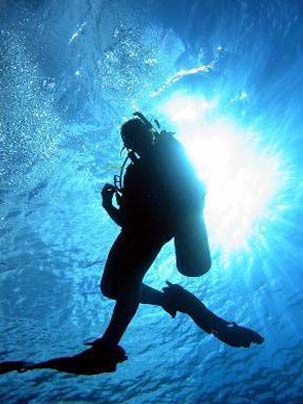
Scuba diving
In scuba diving, a greater water pressure acts on a diver at greater depths. The air pressure inside the body cavities (e.g., lungs, sinuses) must be maintained at the same pressure as that of the surrounding water; otherwise they would collapse. A special value automatically adjusts the pressure of the air breathed from a scuba tank to ensure that the air pressure equals the water pressure at all times. The scuba gear in Figure consists of a 0.0150-m3 tank filled with compressed air at an absolute pressure of 2.02 × 10⁷ Pa. Assuming that the air is consumed at a rate of 0.0300 m3 per minute and that the temperature is the same at all depths., determine how long the diver can stay under seawater at a depth of (a) 10.0 m and (b) 30.0 m.
Reasoning The time (in minutes ) that a scuba diver can remain under water is equal to the volume of air that is available divided by the volume per minute consumed by the diver. The available volume is the volume of air at the pressure P2 breathed by the diver. This pressure is determined by the depth h beneath the surface, according to P2= P1 + ρgh , where P1= 1.01 × 10⁵ Pa is the atmospheric pressure at the surface. Since we know the pressure and volume of air in the scuba tank, and since the temperature is constant, we can use Boyle’s law to find the volume of air available at the pressure P2 .
Solution
Using ρ=1025 kg/m3 for the density of seawater, we find that the absolute pressure P2 at the depth of h= 10.0 m is:
P2 = P1 + ρgh = 1.01 × 10⁵ Pa + (1025 kg/m3)(9.8 m/s2)(10.0 m)
= 2.01 × 10⁵ Pa
The pressure and volume of the air in the tank are Pi =2.02 × 10⁷ Pa and Vi = 0.0150-m3 , respectively. According to Boyle’s law, the volume of air Vf available at a pressure of Pf = 2.01 × 10⁵ Pa is
V_f=((2.01 × 〖10〗^7 Pa)(0.0150 m^3))/(2.01 × 〖10〗^5 Pa)=1.51 m^3
Of this volume, only 1.51 m3 – 0.0150 m3 = 1.50 m3 is available for breathing, because 0.0150 m3 of air always remains in the tank. At a consumption rate of 0.0300 m3/min, the compressed air will last for
t=(1.50 m^3)/(0.0300 m^3/min)=50.0 min
The calculation here is like that in part (a). Equation P2 = P1 + ρgh indicate that at a depth of 30.0 m, the absolute water pressure is 4.02 × 10⁵ Pa. Because this pressure is twice that at the 10.0 m depth. Boyle’s law reveals that the volume of air provided by tank is now only Vf= 0.754 m3. The air available for use is 0.754 m3-0.0150 m3=0.739 m3. At a consumption rate of 0.0300 m3/min, the air will last for t= 24.6 min , so the deeper dive must have a shorter duration.
From:
Physics (6 Edition) Cutnell & Johnson - Wiley International Edition- Page 398-399


No comments:
Post a Comment