Question: What is String Theory?
I've heard the term string theory, but don't really know what it means. How does it relate to quantum physics?
Answer: String theory is a mathematical theory that tries to explain certain phenomena which is not currently explainable under the standard model of quantum physics.
The Basics of String Theory
At its core, string theory uses a model of one-dimensional strings in place of the particles of quantum physics. These strings, the size of the Planck length (i.e. 10-35 m) vibrate at specific resonant frequencies. (NOTE: Some recent versions of string theory have predicted that the strings could have a longer length, up to nearly a millimeter in size, which would mean they're in the realm that experiments could detect them.) The formulas that result from string theory predict more than four dimensions (10 or 11 in the most common variants, though on version requires 26 dimensions), but the extra dimensions are "curled up" within the Planck length.
In addition to the strings, string theory contains another type of fundamental object called a brane, which can have many more dimensions. In some "braneworld scenarios," our universe is actually "stuck" inside of a 3-dimensional brane (called a 3-brane).
String theory was initially developed in the 1970s in an attempt to explain some inconsistencies with the energy behavior of hadrons and other fundamental particles of physics.
As with much of quantum physics, the mathematics that applies to string theory cannot be uniquely solved. Physicists must apply perturbation theory to obtain a series of approximated solutions. Such solutions, of course, include assumptions which may or may not be true.
The driving hope behind this work is that it will result in a "theory of everything," including a solution to the problem of quantum gravity, to reconcile quantum physics with general relativity, thus reconciling the fundamental forces of physics.
Variants of String Theory
Bosonic String Theory: The first string theory, which focused only on bosons.
Superstring Theory: This variant of string theory (short for "supersymmetric string theory") incorporates fermions and supersymmetry. There are five independent superstring theories:
•Type 1
•Type IIA
•Type IIB
•Type HO
•Type HE
M-Theory: A superstring theory, proposed in 1995, which attempts to consolidate the Type I, Type IIA, Type IIB, Type HO, and Type HE models as variants of the same fundamental physical model.
Research in String Theory
At present, string theory has not successfully made any prediction which is not also explained through an alternative theory. It is neither specifically proven nor falsified, though it has mathematical features which give it great appeal to many physicists.
A number of proposed experiments might have the possibility of displaying "string effects." The energy required for many such experiments is not currently obtainable, although some are in the realm of possibility in the near future, such as possible observations from black holes.
Only time will tell if string theory will be able to take a dominant place in science, beyond inspiring the hearts and minds of many physicists.
From:
http://physics.about.com/b/2009/11/04/alternate-universe-countdown.htm
Wednesday, November 25, 2009

Sunday, November 22, 2009
آدرسهای مورد درخواست
در جلسه این هفته که در مورد ترمودینامیک صحبت کردیم، منابعی در اینترنت معرفی شد که بنا به درخواست همکاران آدرسهای آنها در اینجا ذکر می شود.
http://www.physics.ucsd.edu/~tmurphy/phys12/lectures/07_heat.ppt
http://www.blogger.com/www.physics.ucsd.edu/~tmurphy/phys12/lectures/07_heat.ppt
http://www.physics.ucsd.edu/~tmurphy/phys12/lectures/07_heat.ppt
http://me.kaist.ac.kr/upload/course/MAE554_2009/L7_Stirling_2009.ppt
http://www.phy.ntnu.edu.tw/ntnujava/index.php?topic=23
http://www.cs.sbcc.net/~physics/flash/heatengines/Carnot%20cycle.html
http://galileo.phys.virginia.edu/classes/109N/more_stuff/flashlets/carnot.htm
http://www.shermanlab.com/xmwang/myGUI/CarnotG.html
http://www.k-wz.de/vmotor/v_omotore.html
http://www.educypedia.be/education/carjava.htm
Thursday, November 19, 2009
مسئله ای در مورد فشار
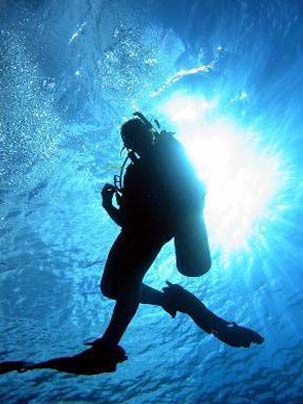
Scuba diving
In scuba diving, a greater water pressure acts on a diver at greater depths. The air pressure inside the body cavities (e.g., lungs, sinuses) must be maintained at the same pressure as that of the surrounding water; otherwise they would collapse. A special value automatically adjusts the pressure of the air breathed from a scuba tank to ensure that the air pressure equals the water pressure at all times. The scuba gear in Figure consists of a 0.0150-m3 tank filled with compressed air at an absolute pressure of 2.02 × 10⁷ Pa. Assuming that the air is consumed at a rate of 0.0300 m3 per minute and that the temperature is the same at all depths., determine how long the diver can stay under seawater at a depth of (a) 10.0 m and (b) 30.0 m.
Reasoning The time (in minutes ) that a scuba diver can remain under water is equal to the volume of air that is available divided by the volume per minute consumed by the diver. The available volume is the volume of air at the pressure P2 breathed by the diver. This pressure is determined by the depth h beneath the surface, according to P2= P1 + ρgh , where P1= 1.01 × 10⁵ Pa is the atmospheric pressure at the surface. Since we know the pressure and volume of air in the scuba tank, and since the temperature is constant, we can use Boyle’s law to find the volume of air available at the pressure P2 .
Solution
Using ρ=1025 kg/m3 for the density of seawater, we find that the absolute pressure P2 at the depth of h= 10.0 m is:
P2 = P1 + ρgh = 1.01 × 10⁵ Pa + (1025 kg/m3)(9.8 m/s2)(10.0 m)
= 2.01 × 10⁵ Pa
The pressure and volume of the air in the tank are Pi =2.02 × 10⁷ Pa and Vi = 0.0150-m3 , respectively. According to Boyle’s law, the volume of air Vf available at a pressure of Pf = 2.01 × 10⁵ Pa is
V_f=((2.01 × 〖10〗^7 Pa)(0.0150 m^3))/(2.01 × 〖10〗^5 Pa)=1.51 m^3
Of this volume, only 1.51 m3 – 0.0150 m3 = 1.50 m3 is available for breathing, because 0.0150 m3 of air always remains in the tank. At a consumption rate of 0.0300 m3/min, the compressed air will last for
t=(1.50 m^3)/(0.0300 m^3/min)=50.0 min
The calculation here is like that in part (a). Equation P2 = P1 + ρgh indicate that at a depth of 30.0 m, the absolute water pressure is 4.02 × 10⁵ Pa. Because this pressure is twice that at the 10.0 m depth. Boyle’s law reveals that the volume of air provided by tank is now only Vf= 0.754 m3. The air available for use is 0.754 m3-0.0150 m3=0.739 m3. At a consumption rate of 0.0300 m3/min, the air will last for t= 24.6 min , so the deeper dive must have a shorter duration.
From:
Physics (6 Edition) Cutnell & Johnson - Wiley International Edition- Page 398-399
Tuesday, November 3, 2009
Misconceptions
یکی از موضوعات جالبی که با آن در اینترنت برخورد کردم، بدفهمی یا کج فهمی موضوعات فیزیک است، که اگر رخ دهد، بزحمت می توان آنرا یا اثراتش را زدود. بنابراین آدرس زیر را معرفی می کنم، که می توانید با رجوع به آن مطالبی را در این
زمینه بخوانید. البته این موضوع جلسات آینده ما نیز خواهد بود.
Monday, October 26, 2009
Problems for the 23rd IYPT 2010
http://www.iypt.at/en/iypt2010/problems/
1. Electromagnetic cannon
A solenoid can be used to fire a small ball. A capacitor is used to energize the solenoid coil. Build a device with a capacitor charged to a maximum 50V. Investigate the relevant parameters and maximize the speed of the ball.
2. Brilliant pattern
Suspend a water drop at the lower end of a vertical pipe. Illuminate the drop using a laser pointer and observe the pattern created on a screen. Study and explain the structure of the pattern.
3. Steel balls
Colliding two large steel balls with a thin sheet of material (e.g. paper) in between may "burn" a hole in the sheet. Investigate this effect for various materials.
4. Soap film
Create a soap film in a circular wire loop. The soap film deforms when a charged body is placed next to it. Investigate how the shape of the soap film depends on the position and nature of the charge.
5. Grid
A plastic grid covers the open end of a cylindrical vessel containing water. The grid is covered and the vessel is turned upside down. What is the maximal size of holes in the grid so that water does not flow out when the cover is removed?
6. Ice
A wire with weights attached to each end is placed across a block of ice. The wire may pass through the ice without cutting it. Investigate the phenomenon.
7. Two flasks
Two similar flasks (one is empty, one contains water) are each connected by flexible pipes to a lower water reservoir. The flasks are heated to 100C and this temperature is held for some time. Heating is stopped and as the flasks cool down, water is drawn up the tubes. Investigate and describe in which tube the water goes up faster and in which the final height is greater. How does this effect depend on the time of heating?
8. Liquid light guide
A transparent vessel is filled with a liquid (e.g. water). A jet flows out of the vessel. A light source is placed so that a horizontal beam enters the liquid jet (see picture). Under what conditions does the jet operate like a light guide?
9. Sticky water
When a horizontal cylinder is placed in a vertical stream of water, the stream can follow the cylinders circumference along the bottom and continue up the other side before it detaches. Explain this phenomenon and investigate the relevant parameters.
10. Calm surface
When wind blows across a water surface, waves can be observed. If the water is covered by an oil layer, the waves on the water surface will diminish. Investigate the phenomenon.
11. Sand
Dry sand is rather 'soft' to walk on when compared to damp sand. However sand containing a significant amount of water becomes soft again. Investigate the parameters that affect the softness of sand.
12. Wet towels
When a wet towel is flicked, it may create a cracking sound like a whip. Investigate the effect. Why does a wet towel crack louder than a dry one?
13. Shrieking rod
A metal rod is held between two fingers and hit. Investigate how the sound produced depends on the position of holding and hitting the rod?
14. Magnetic spring
Two magnets are arranged on top of each other such that one of them is fixed and the other one can move vertically. Investigate oscillations of the magnet.
15. Paper anemometer
When thin strips of paper are placed in an air flow, a noise may be heard. Investigate how the velocity of the air flow can be deduced from this noise?
16. Rotating spring
A helical spring is rotated about one of its ends around a vertical axis. Investigate the expansion of the spring with and without an additional mass attached to its free end.
17. Kelvins dropper
Construct Kelvin's dropper. Measure the highest voltage it can produce. Investigate its dependence on relevant parameters.
1. Electromagnetic cannon
A solenoid can be used to fire a small ball. A capacitor is used to energize the solenoid coil. Build a device with a capacitor charged to a maximum 50V. Investigate the relevant parameters and maximize the speed of the ball.
2. Brilliant pattern
Suspend a water drop at the lower end of a vertical pipe. Illuminate the drop using a laser pointer and observe the pattern created on a screen. Study and explain the structure of the pattern.
3. Steel balls
Colliding two large steel balls with a thin sheet of material (e.g. paper) in between may "burn" a hole in the sheet. Investigate this effect for various materials.
4. Soap film
Create a soap film in a circular wire loop. The soap film deforms when a charged body is placed next to it. Investigate how the shape of the soap film depends on the position and nature of the charge.
5. Grid
A plastic grid covers the open end of a cylindrical vessel containing water. The grid is covered and the vessel is turned upside down. What is the maximal size of holes in the grid so that water does not flow out when the cover is removed?
6. Ice
A wire with weights attached to each end is placed across a block of ice. The wire may pass through the ice without cutting it. Investigate the phenomenon.
7. Two flasks
Two similar flasks (one is empty, one contains water) are each connected by flexible pipes to a lower water reservoir. The flasks are heated to 100C and this temperature is held for some time. Heating is stopped and as the flasks cool down, water is drawn up the tubes. Investigate and describe in which tube the water goes up faster and in which the final height is greater. How does this effect depend on the time of heating?
8. Liquid light guide
A transparent vessel is filled with a liquid (e.g. water). A jet flows out of the vessel. A light source is placed so that a horizontal beam enters the liquid jet (see picture). Under what conditions does the jet operate like a light guide?
9. Sticky water
When a horizontal cylinder is placed in a vertical stream of water, the stream can follow the cylinders circumference along the bottom and continue up the other side before it detaches. Explain this phenomenon and investigate the relevant parameters.
10. Calm surface
When wind blows across a water surface, waves can be observed. If the water is covered by an oil layer, the waves on the water surface will diminish. Investigate the phenomenon.
11. Sand
Dry sand is rather 'soft' to walk on when compared to damp sand. However sand containing a significant amount of water becomes soft again. Investigate the parameters that affect the softness of sand.
12. Wet towels
When a wet towel is flicked, it may create a cracking sound like a whip. Investigate the effect. Why does a wet towel crack louder than a dry one?
13. Shrieking rod
A metal rod is held between two fingers and hit. Investigate how the sound produced depends on the position of holding and hitting the rod?
14. Magnetic spring
Two magnets are arranged on top of each other such that one of them is fixed and the other one can move vertically. Investigate oscillations of the magnet.
15. Paper anemometer
When thin strips of paper are placed in an air flow, a noise may be heard. Investigate how the velocity of the air flow can be deduced from this noise?
16. Rotating spring
A helical spring is rotated about one of its ends around a vertical axis. Investigate the expansion of the spring with and without an additional mass attached to its free end.
17. Kelvins dropper
Construct Kelvin's dropper. Measure the highest voltage it can produce. Investigate its dependence on relevant parameters.
Sunday, October 25, 2009
Saturday, October 24, 2009
Measurment
http://www.thestudentroom.co.uk/wiki/Revision:Measurement
1.1 Standards of measurement
1.1.1 : Fundamental and derived units
Fundamental units are, in general those which can't be expressed in terms of others (there are exceptions). Mass, length, time, electric current (this is defined in terms of force between wires, but is fundamental in terms of electric circuits). The newton is a derived unit, because it is defined as the force required to accelerate 1kg at 1 ms-2. Other derived units include Power (work x time), Pressure (force per unit area), density (mass per unit volume).
1.1.2 : Definition of some fundamental units
Kilogram...a measure of mass, defined by a platinum-iridium cylinder kept in Sevres, France (Though I really can't imagine the IB asking that :)
Meter...unit of distance, defined as the distance traveled by light in sec, where the speed of light (about 3 x 10⁸ m/sec).
Second...unit of time, based on time taken the number of vibrations in a cesium atom (9.1 x 10 ).
1.2 Vectors and scalars
1.2.1
Vector quantities have both a magnitude, and a direction. Scalar quantities have only a magnitude. Vector quantities are those such as displacement, velocity, acceleration. Scalar quantities are distance, speed, work and energy (those last two are important...apparently)
1.2.2
Vectors can be represented as lines, where the length is the magnitude and the direction is the direction on the paper. Vectors can be added by using a scale diagram...The first vector is drawn, then the second from the end of the first, and so on. The resultant vector goes from the beginning of the first to the end of the last...in that direction, not the other way.
1.2.3
Multiplying or dividing a vector by a scalar only affects the magnitude, not the direction...and works just like normal multiplication / dividing.
1.2.4
Place the vector as a diagonal of a rectangle...this allows the vertical and horizontal components to be calculated by pythag and basic trig. The sum of all the vertical components = the vertical component of the resultant vector and so for the horizontal.
1.3 Graphical techniques
1.3.1
Graphs should be drawn with the dependent variable on the vertical axis (unless the slop is supposed to be a particular unit over another, in which case use that). Usually only the dependent variable uncertainties are relevant, which means you only need vertical uncertainty bars ( and make sure you have a title, and label both axes...it's not like it requires any skill, and yet they still give marks for it :) Draw a line of best fit, usually a straight line, but not always...some points will probably have to be discarded, just to make things fun.
1.3.2
The units of the constant defining the slope of the graph will be . The range of possible slopes can be found by taking a maximum line of 'best' fit and a minimum line of 'best' fit using the uncertainty bars...Physics doesn't have to obey the foolish laws of grammar :)
The intercepts' relevance varies from graph to graph...in general, the intercept is the value of one component when the other is zero...ie on a temp vs pressure graph, the intercept will be a -273 c...representing absolute zero.
1.3.3
By playing around with powers (including negative powers) you can get a linear graph, from which it is much simple to determine the relationship. When you have a straight line which goes through the origin, the unit on the vertical axis is directly proportional to that on the horizontal axis.
1.3.4
Any straight line graph can be put in the form , where the slope and the intercept. Nb...If is not zero, then they are not directly proportional.
1.3.5
sin, or other repeating graphs have the following characteristics...amplitude -- the difference between the highest and lowest y values...Wavelength is the distance from the top of the crest of a wave to the top of the next crest (or equivalently, the distance between successive identical parts of a wave.) Period is the time required to complete one cycle ex. time for a pendulum to make one back and forth swing... frequency -- usually relevant in graphs against time, where frequency is the number of cycles per second...
1.3.6
Draw bar graphs...choose the appropriate intervals (they should all be of the same width, not too large or small to mask trends) and then find trends...Millikan's oil drop...the bars all differ by the same amount (the charge of an electron)...the frequency of values may increase or decrease with larger, or smaller values.
1.4 Uncertainties and errors
1.4.1
Uncertainties are due to lack of precision in measuring equipment, errors are actual inaccuracies ie equipment being mis-used, or mis-measurements...Uncertainties could come from the fact that a rule is only marked down to 1 mm, Errors could come if you miss read 15 on the ruler as 14...Uncertainties cause uncertainty bard, errors usually result in the particular piece of data being discarded.
1.4.2
Random uncertainties result from the magical randomness of measuring equipment...sometimes the jaws of a micrometer will close one way, sometimes another...they're random, and you can't do anything about them. Systematic errors are those built into the equipment.
1.4.3
Record uncertainty along with data. The minimum uncertainty is half the limit of the reading...ie if the measurement is 3.6g, then the uncertainty is ± 0.05g.
1.4.4
Random uncertainties are found by measuring the greatest difference from the arithmetic mean of the values...this decreases, at first rapidly and then more slowly as more data is collected. By using graphs we can obtain a line of best fit which wits within all the uncertainties.
1.4.5
When adding or subtracting, the uncertainty is the sum of the absolute uncertainties for each term. When multiplying or dividing, the uncertainty is the sum of the relative uncertainties (ie )...this can result in large uncertainties being created by performing operations on data with small uncertainties.
1.1 Standards of measurement
1.1.1 : Fundamental and derived units
Fundamental units are, in general those which can't be expressed in terms of others (there are exceptions). Mass, length, time, electric current (this is defined in terms of force between wires, but is fundamental in terms of electric circuits). The newton is a derived unit, because it is defined as the force required to accelerate 1kg at 1 ms-2. Other derived units include Power (work x time), Pressure (force per unit area), density (mass per unit volume).
1.1.2 : Definition of some fundamental units
Kilogram...a measure of mass, defined by a platinum-iridium cylinder kept in Sevres, France (Though I really can't imagine the IB asking that :)
Meter...unit of distance, defined as the distance traveled by light in sec, where the speed of light (about 3 x 10⁸ m/sec).
Second...unit of time, based on time taken the number of vibrations in a cesium atom (9.1 x 10 ).
1.2 Vectors and scalars
1.2.1
Vector quantities have both a magnitude, and a direction. Scalar quantities have only a magnitude. Vector quantities are those such as displacement, velocity, acceleration. Scalar quantities are distance, speed, work and energy (those last two are important...apparently)
1.2.2
Vectors can be represented as lines, where the length is the magnitude and the direction is the direction on the paper. Vectors can be added by using a scale diagram...The first vector is drawn, then the second from the end of the first, and so on. The resultant vector goes from the beginning of the first to the end of the last...in that direction, not the other way.
1.2.3
Multiplying or dividing a vector by a scalar only affects the magnitude, not the direction...and works just like normal multiplication / dividing.
1.2.4
Place the vector as a diagonal of a rectangle...this allows the vertical and horizontal components to be calculated by pythag and basic trig. The sum of all the vertical components = the vertical component of the resultant vector and so for the horizontal.
1.3 Graphical techniques
1.3.1
Graphs should be drawn with the dependent variable on the vertical axis (unless the slop is supposed to be a particular unit over another, in which case use that). Usually only the dependent variable uncertainties are relevant, which means you only need vertical uncertainty bars ( and make sure you have a title, and label both axes...it's not like it requires any skill, and yet they still give marks for it :) Draw a line of best fit, usually a straight line, but not always...some points will probably have to be discarded, just to make things fun.
1.3.2
The units of the constant defining the slope of the graph will be . The range of possible slopes can be found by taking a maximum line of 'best' fit and a minimum line of 'best' fit using the uncertainty bars...Physics doesn't have to obey the foolish laws of grammar :)
The intercepts' relevance varies from graph to graph...in general, the intercept is the value of one component when the other is zero...ie on a temp vs pressure graph, the intercept will be a -273 c...representing absolute zero.
1.3.3
By playing around with powers (including negative powers) you can get a linear graph, from which it is much simple to determine the relationship. When you have a straight line which goes through the origin, the unit on the vertical axis is directly proportional to that on the horizontal axis.
1.3.4
Any straight line graph can be put in the form , where the slope and the intercept. Nb...If is not zero, then they are not directly proportional.
1.3.5
sin, or other repeating graphs have the following characteristics...amplitude -- the difference between the highest and lowest y values...Wavelength is the distance from the top of the crest of a wave to the top of the next crest (or equivalently, the distance between successive identical parts of a wave.) Period is the time required to complete one cycle ex. time for a pendulum to make one back and forth swing... frequency -- usually relevant in graphs against time, where frequency is the number of cycles per second...
1.3.6
Draw bar graphs...choose the appropriate intervals (they should all be of the same width, not too large or small to mask trends) and then find trends...Millikan's oil drop...the bars all differ by the same amount (the charge of an electron)...the frequency of values may increase or decrease with larger, or smaller values.
1.4 Uncertainties and errors
1.4.1
Uncertainties are due to lack of precision in measuring equipment, errors are actual inaccuracies ie equipment being mis-used, or mis-measurements...Uncertainties could come from the fact that a rule is only marked down to 1 mm, Errors could come if you miss read 15 on the ruler as 14...Uncertainties cause uncertainty bard, errors usually result in the particular piece of data being discarded.
1.4.2
Random uncertainties result from the magical randomness of measuring equipment...sometimes the jaws of a micrometer will close one way, sometimes another...they're random, and you can't do anything about them. Systematic errors are those built into the equipment.
1.4.3
Record uncertainty along with data. The minimum uncertainty is half the limit of the reading...ie if the measurement is 3.6g, then the uncertainty is ± 0.05g.
1.4.4
Random uncertainties are found by measuring the greatest difference from the arithmetic mean of the values...this decreases, at first rapidly and then more slowly as more data is collected. By using graphs we can obtain a line of best fit which wits within all the uncertainties.
1.4.5
When adding or subtracting, the uncertainty is the sum of the absolute uncertainties for each term. When multiplying or dividing, the uncertainty is the sum of the relative uncertainties (ie )...this can result in large uncertainties being created by performing operations on data with small uncertainties.
Subscribe to:
Comments (Atom)
